
Leading from the Field
Twelve Principles for Energetic Stewardship
by
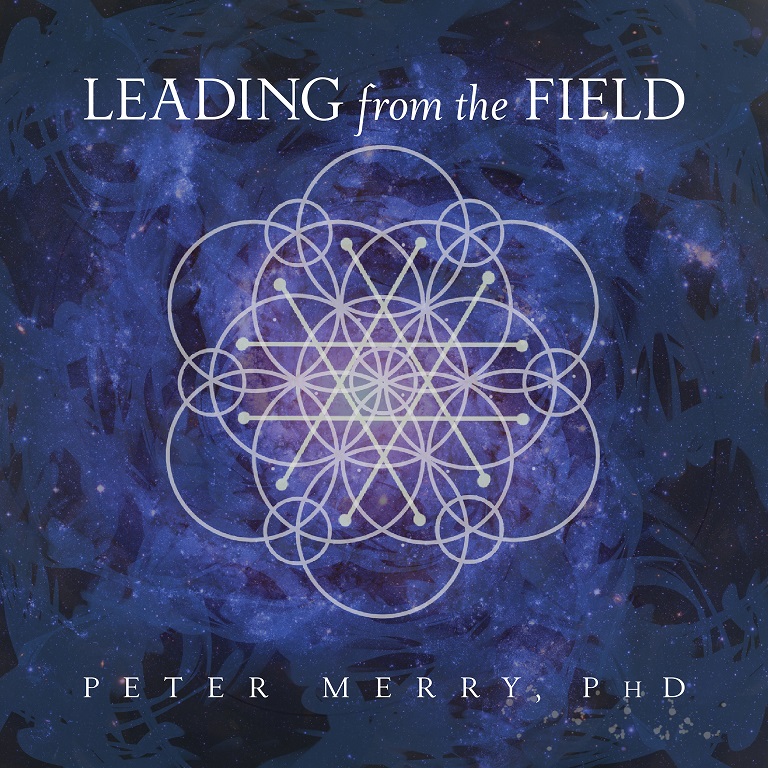
If we assume, as both the new scientists and ancient wisdom traditions tell us, that all of reality is actually composed of interlocking dynamic energy fields, that life is a continuous process of organising energetic information into form, then what does that mean for the way we need to lead our organisations, be they business, civil society, government, community, or even family systems? To growth, differentiation, and intellect, we need to add stillness, oneness, and intuition. This book is a short beginner’s “field guide” on how to perceive, interpret, and enhance the energetic fields of the collective systems that we lead. The illustrations and accompanying text are designed to remind us of the core principles and practices of resonant leadership and energetic stewardship.
Diane Williams, Initiator The Evolutionary Leaders Circle wrote:Wise, inspiring and beautiful.
Rafia Morgan wrote:Connect to the essence of this beautifully powerful, captivating book. Prepare for your life and work to be forever changed.
Brenda Dunne, President of International Consciousness Research Laboratories wrote:The reset button the leadership world has been waiting for.
David Lorimer, Scientific and Medical Network wrote:These principles guide the creative development of all living systems, at all levels, from the microscopic to the Universal.
Reads like a ‘Tao of Leadership.
Other Books By Peter Merry PhD
Evolutionary Leadership
For an Increasingly Complex World
by

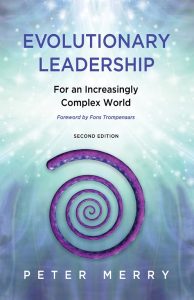
Evolutionary Leadership meets the current demand for a holistic vision that can take the measure of today’s increasingly complex society. Peter Merry is one of the first to have applied this integral approach to leadership, combining theory and practice inspired by, among others, Ken Wilber, Dr Don Beck and Otto Scharmer. The result is relevant not only for organisations, but also for our communities and personal lives. Illustrated with stories from the field, Evolutionary Leadership is a rich source of ideas, inspiration and practices for engaging the world of today.
Herman Wijffels, former CEO Rabobank and Director of the World Bank wrote:A must read for those who are struggling to identify and connect more of the dots.
Prof. Ervin Laszlo wrote:Read this and be prepared to take responsibility.
Marianne de Jager and Rene van den Berg, IBM BeneLux wrote:Recommended reading for everyone seeking to be a responsible, aware, and modest but true leader.
In IBM (Netherlands) we applied Peter Merry’s ideas with great success.
Other Books By Peter Merry PhD
Integral City 3.7 (Book 3)
Reframing Complex Challenges for Gaia's Human Hives
by
Integral City 3.7 considers a series of apparently intractable challenges that all cities face because the world has become so complex that cause and effect are rarely directly linked. This third book in our series explores three themes that are eternal practices for designing a collective life that works for all life; namely, Caring, Contexting and Capacity Building. The challenges cities face today result from the intertwining impacts of multiple life conditions, perspectives and capacities and can only be addressed by reframing them within an Integral City model that honors the plural realities, recognizes their developmental and evolutionary relationships and does not conflate differences. Book 3 applies and expands in multiple directions the 12 intelligences described in Book 1, Integral City: Evolutionary Intelligences for the Human Hive and builds on the field work described in Book 2: Integral City Inquiry & Action: Designing Impact for the Human Hive.
Terry Patten, Author A New Republic of the Heart: An Ethos for Revolutionaries wrote:Only an integrally pluralistic theory and practice like Integral City can reframe complexity into a genuinely integral approach that serves our most complex human systems.
Paul van Schaik, Founder IntegralMENTORS wrote:Book 3 of the Integral City Series explores three practices for designing a collective urban life that works for all life; namely, Caring, Contexting and Capacity Building. It expands in multiple directions the 12 intelligences described in Book 1, Integral City: Evolutionary Intelligences for the Human Hive and builds on the field work of Book 2, Integral City Inquiry & Action: Designing Impact for the Human Hive.
Ian Wight PhD FCIP GTB, Senior Scholar City Planning, University of Manitoba wrote:Marilyn’s Integral City 3.7 and the other two earlier volumes are part of the evolving process that defines the actions we all need to be involved in if our cities are to be places we love to be a part of.
Alexander Laszlo, PhD, 57th President of the International Society for the Systems Sciences (ISSS) and Chair of the Board of Trustees wrote:In bald terms the call in this book is to aim for an overview that is not only an integration-in-action but also a spirituality-in-action. As a grandmother caring deeply for the world being bequeathed to her granddaughter, the author models ‘integral’ as a reframe of ‘professional’, and we wonder—who might be inclined to follow her example?
Hamilton’s third book is a handbook for stewards of the growth and structure of living cities as well as for curators of complex evolutionary learning communities. Her work explores the scientific bases for the emergence of collective wellbeing in hypercomplex human communities and their potential for expressing intelligence through networked connections between and among them. In a VUCA age, Hamilton’s work is an essential guide for understanding the evolution of a city as a learning system and how to fulfill it’s potential as a true expression of Gaia.

Other Books By Marilyn Hamilton
Integral City Inquiry and Action (Book 2)
Designing Impact for the Human Hive
by
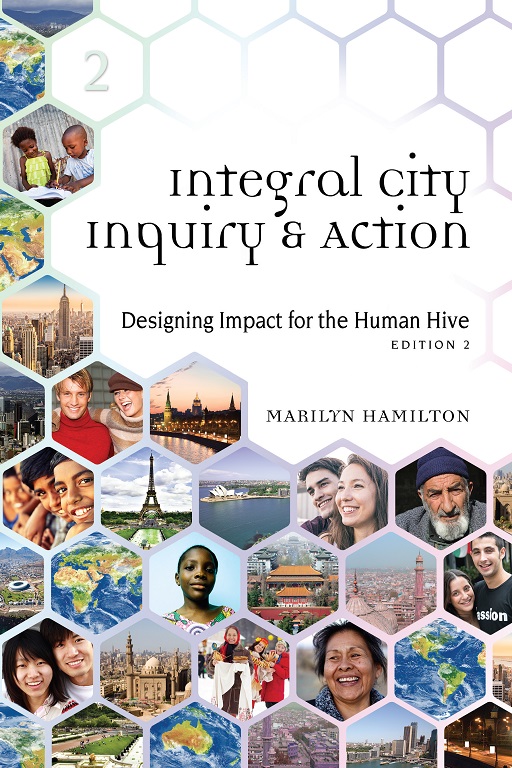
Learn through a series of methodological cases studies and templates for process designs, based on Integral City work in the last decade. If you want to achieve impact in your work as Integral City Practitioner, Catalyst or Meshworker, these designs generate outcomes in the city as a whole, using an integrally framed approach. You can address consciousness and culture as Place Caring (the left had quadrants of the integral model) and actions and systems as Place Making (the right hand quadrants of the integral model). Organized using the Integral City design cycle the chapters walk you through processes for inviting in the Knowing Field; embracing the Master Code; assessing the 12 Intelligences of the City; discovering and mapping City Values; designing Vital Signs Monitors; engaging the 4 Voices of the City; Prototyping designs for Learning Lhabitats, Pop-ups and Sustainable Community Development; Meshworking Purpose, People, Place and Planet; and Evaluating Outcomes. Using these process designs you may choose a linear or a non-linear path. Whether you focus on separate stages or attempt the whole tour, you will find an inquiry-action-impact system that is replicable, frequently iterative and provides a grand cycle for enacting change at the city scale.
Ken Wilber, Philosopher, Integral Theorist wrote:Our planet urgently needs integral cities. Imagine living in a world where more and more cities are modeling how they can serve personal, civic, and global well-being. Start reading this book to see how you can transform this shared vision into shared action.
Hilary Bradbury, PhD, Professor (OHSU) wrote:Integral City Inquiry & Action tells us that only an integrally pluralistic theory and practice will cover all the truly important bases [to developing the city as our most complex human system]. These important bases are carefully elucidated in 16 chapters, each one covering a significant ingredient of a genuinely integral approach to city planning, living, exploring, discovering, applying. My congratulations to the authors for another profound, timely, and superb work!
Lisa Norton, Professor of Design Leadership and Associate Dean, School of Design Strategies, Parsons School of Design, New York, NY wrote:This book offers tons of great questions and grounded frameworks that help us articulate Gaia’s reflective capacity. It’s a resource for action researchers in the field of urban planning and perhaps for all whole systems/integration oriented professionals.
This leading-edge book is a gift to next generation urban change workers. Its elegant and accessible structure, fresh models and integrating tools are the product of iterative testing over many years in contexts of place-based yet globally shared challenges faced by 21st century architects, planners, city managers, developers, designers, communities, investors and activists.
Other Books By Marilyn Hamilton
Integral City (Book 1), Edition 2
Evolutionary Intelligences for the Human Hive
by
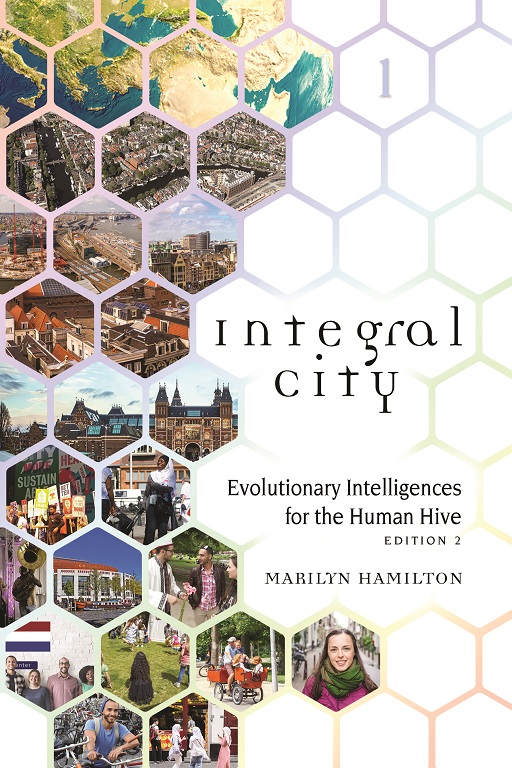
How are we evolving the human hive? 60% of humanity now lives in cities. Can city dwellers, like bees who pollinate the fields, act so intelligently that they add value to the planet? How can the clash of differences that separate people, purpose, profits, and priorities generate fresh energy to solve 21st-century VUCA problems? How do we propagate new pathways for community learning and give the 4 Voices of the city fresh hope?
For City Leaders, Business/Innovators, the 3rd Sector and Citizens, this book proposes 5 sets of City Intelligences: Contexting, Individual, Collective, Strategic, and Evolutionary. It explores a new paradigm that senses, experiences, relates, and co-creates in--with and as the city--using an Integral consciousness.
Integral City recalibrates city intelligences with the Master Code of Care--for Self, Others, Place, and Planet. Its life-giving strategies reveal cities as Gaia's Reflective Organs, evolving futures in space.
Elisabet Sahtouris, Evolution Biologist wrote:Marilyn Hamilton was an early researcher of Integral frameworks. Integral City Edition 2 is a significant application of the Integral model to the city scale of human systems. With more than 60% of humanity now living in cities, I recommend you learn how Integral City gives us critical intelligences to evolve the human hive.
Ian Wight PhD, Associate Professor of City Planning, Faculty of Architecture, University of Manitoba (ret) wrote:Integral City recalibrates city intelligences with the Master Code of Care—for Self, Others, Place and Planet. Its life-giving strategies reveal cities, as Gaia’s Reflective Organs, evolving futures in space.
Every city can enhance its own health with the unique and wonderful tools of this book and its field book, which enable readers to go deeply into, and thus truly understand, their city’s collective human psyche along with its physical infrastructure and thus to move forward in the way of genuine living entities. Read this book, share it with every ally you can, take it to your City Hall and get moving. There is a better world for us all ahead!
Sean Esbjörn-Hargens Co-author of Integral Ecology; Founder MetaIntegral; Exec. Editor Journal of Integral Theory and Practice; and Past Chair of the Integral Theory Department at John. F. Kennedy University wrote:. . . a veritable eco-city planning and design manifesto for anyone whose business touches on any aspect of city-making, city-managing and city-sustaining.
Integral City provides an important vision that promises to allow both people and planet to flourish. With the meta-framework presented here, Marilyn Hamilton joins and extends the integrative tradition of Patrick Geddes, Lewis Mumford, and Jane Jacobs. In particular she helps us understand the myriad connections between behavioral and systemic dimensions of urban landscapes with the psychological and cultural aspects.
Other Books By Marilyn Hamilton
Where Did Mommy Go?
by

This book was written for young children to help them understand why mommy or daddy has to go away for an extended time to a treatment center to "get better." This can seem like a difficult conversation to have with a 3-6-year old. Children of this age may not understand why their parent is going away and can be confused and even frightened. In many cases, they may know on some level that there is something going on, and often a simple explanation will suffice, that mommy or daddy is going away for a while to get better and that they will return soon. Explaining to a child that they will be safe and taken care of while their parent is gone will help them feel confident in this new change in their life.
In this book, Spook's mommy is going to a treatment center so she can get better and doesn't have to drink her strange milk anymore. Parents going into treatment will also benefit by sharing this book with their 3-6-year old, opening up communication and making the explanation easier.
Mallory Fuchs, LADC, Chemical Health Specialist wrote:This book offers a direct explanation, with simple language and beautiful illustrations, while addressing a difficult family topic of what is happening when a parent goes to treatment. I am a counselor and a person in recovery, as well as an Adult Child of an Alcoholic, so I know how hard these conversations can be, especially for young children. The book is written in simple language that makes it easy for children to understand. This would be a wonderful resource for parents who are going to treatment. I especially like the Tips and Resource List at the end.
I think its great! I also think its perfect for the younger age audience to explain and also liked that you put resources in the back. I work in the schools and think this would be great in our elementary schools!

Why Work?
Economics and Work for People and Planet
by
Size: 5.00 x 8.00 in
Pages: 144
Pages: 94

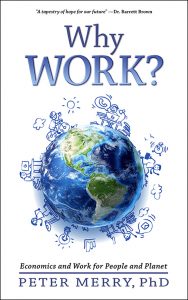
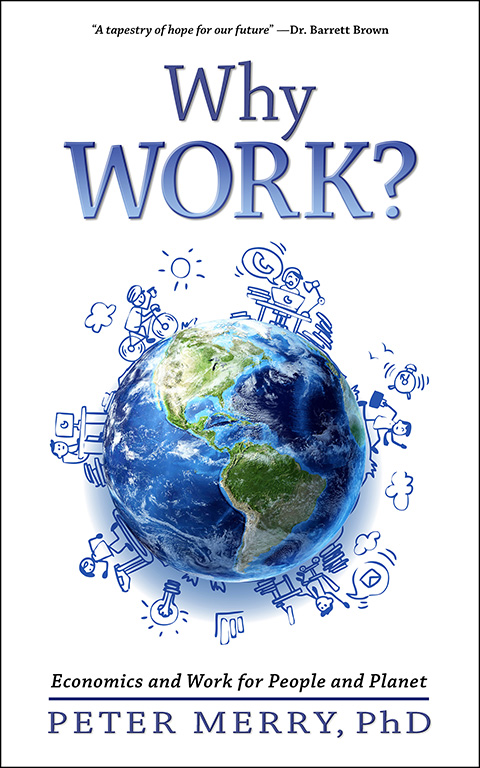
We humans are born to be full of life, expressing all different parts of ourselves through creativity while building a vibrant world together. The current world of work deadens this human potential by only valuing that which adds to abstract economic indicators and deprives us of the time and space to contribute in ways that are meaningful and empowering. Why Work? shows us how we can change our policies, take action directly in our communities to carve out the space for us to reclaim our humanity, and engage in activities that reward our deeper needs, our communities and our planet as a whole. This is the Why of Work.
Prof. Wayne Visser wrote:Peter Merry’s book addresses a central question faced by every human: Why should we work? His overview is lively, direct, readable, and very timely. With technological advances threatening to continue to eat away at employable jobs, new solutions are ever-more urgently required for human daily survival. Peter’s work looks at this issue head-on, with both analyses and possible solutions. Well done!
Barrett C. Brown, PhD. wrote:Why Work? is a brave treatise that refuses to shy away from Western capitalism’s most vexing dilemmas, such as how to create meaningful work and halt the social cancer of growing inequality. Merry effortlessly weaves together philosophical, economic, political and even spiritual perspectives into a highly readable book that is as grounded in pragmatic solutions as it is uplifted by inspiring aspirations. Many of the policy ideas are rooted in the decades old “new economics” and “green politics” movements, which are only recently being taken up and stress tested by various governments around the world, especially in Europe. This makes the book highly contemporary and recommended reading for changemakers in government, business, civil society and academia. A fertile and far-reaching book of possible futures.
Once again, Peter Merry is years ahead with his thinking about global flourishing and what it takes for us to bring about a future that works for all. In this work he deftly weaves a tapestry of hope for our future from the threads of ecological economics, consciousness development, and social change theory. This mash-up of paradigms and trans-disciplinary thinking, combined with examples of practical, liberating structures for the individual and collective, is precisely the grounded wisdom that will stimulate real change. With this text, he will continue to positively influence those with authority, power, and influence for many years to come.